

Switching all wood and coal burning fires to electric fires could cut CO2 emissions in the UK by the same amount as removing around two million cars from the roads.
A switch from wood and coal burners to electric fires could save an estimated 10.66 million tonnes of CO2 annually, according to Endeavour Fires.
Electric outshines coal
Wood-burning stoves and open fires are still hugely popular in the UK despite restrictions on burning such fuels in certain areas.
Around 2.7 million homes – roughly 1 in 10 homes – are using them, according to the British Heart Foundation.
The current CO2 emissions from wood and coal burners is estimated to be around 17.46 million tonnes of CO2 annually.
Electric fires, on the other hand, only account for around 6.80 million tonnes of CO2 annually – a difference of 10.66 million tonnes of CO2 annually.
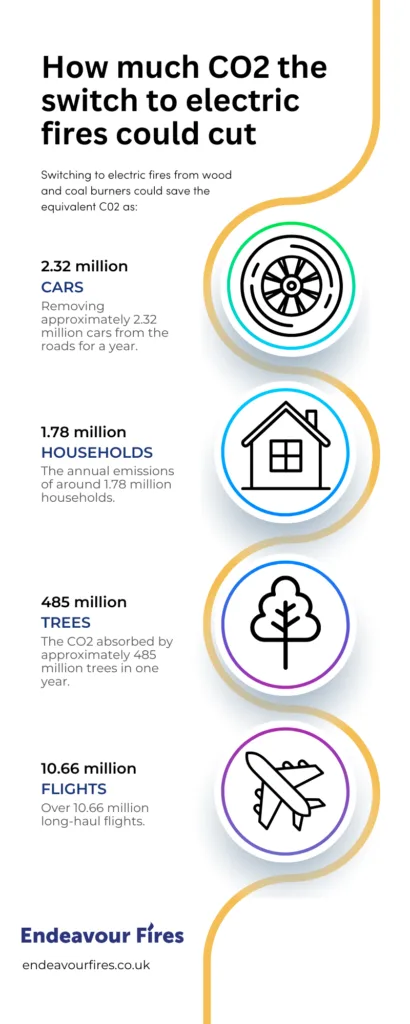
How much CO2 the switch to electric fires could cut
Below shows what 10.66 million tonnes of savings is equivalent to:
- Removing approximately 2.32 million cars from the roads for a year.
- The annual emissions of around 1.78 million households.
- The CO2 absorbed by approximately 485 million trees in one year.
- The emissions of 1,777 villages over a year.
- Over 10.66 million long-haul flights.
Advocacy groups like Action for Clean Air[1] have called for a complete phase-out of domestic wood burning by 2030.
The UK has a target to achieve net-zero carbon emissions by 2050, with interim goals such as a 68% reduction by 2030 and 78% by 2037, compared to 1990 levels.
Reducing emissions from domestic heating, including the use of wood and coal, is integral to these targets[2].
Not just CO2 – air pollution would drop as well
As well as their CO2 impact, burning wood and coal also contributes significantly to air pollution.
Switching from these types of fireplaces to electric fireplaces would also significantly reduce air pollution.
In 2019, domestic burning of such fuels was responsible for 43% of the UK’s total PM2.5 emissions, a harmful particulate matter linked to various health issues, according to Defra Media.
Electric fires produce zero PM2.5 emissions.
The health impacts of PM2.5 emissions are considerable. These include an increased risk of heart disease, chronic bronchitis, reduced lung function, and lung cancer in the long term[3].
It has also been associated with an increased risk of stroke, type 2 diabetes, obesity, systemic inflammation, Alzheimer’s disease, and dementia[4].
How we calculated these figures
Wood burners produce an estimated 0.38 kg of CO2 per kWh of heat energy produced, while coal burners produce around 0.91 kg[5][6].
With an estimated mix of 70% wood and 30% coal burners in these households, the average energy consumption is 12,000 kWh/year per household[7].
The CO2 emissions from UK electricity generation is around 0.21 kg of CO2 per kWh.
CO2 emissions per household:
- Wood: 12,000 kWh×0.38 kg CO2/kWh12,000
- Coal: 12,000 kWh×0.91 kg CO2/kWh12,000
- Weighted average: (0.7×0.38)+(0.3×0.91) kg CO2/kWh
[1] https://www.actionforcleanair.org.uk/evidence-resources/policy-pathway-to-reduce-air-pollution-by-phasing-out-domestic-burning-by-2030
[2] https://commonslibrary.parliament.uk/research-briefings/cbp-9888/
[3] https://www.health.ny.gov/environmental/indoors/air/pmq_a.htm
[4] https://www.eea.europa.eu/en/topics/in-depth/air-pollution/eow-it-affects-our-health
[5] https://assets.publishing.service.gov.uk/media/64dc8d3960d123000d32c602/biomass-strategy-2023.pdf
[6] https://www.gov.uk/government/collections/government-conversion-factors-for-company-reporting
[7][7] https://assets.publishing.service.gov.uk/government/uploads/system/uploads/attachment_data/file/517572/Summary_results_of_the_domestic_wood_use_survey_.pdf?utm_source=chatgpt.com